

In No Stupid Questions episode #173: “How Important Is Your Choice of Words”, Angela Duckworth and Mike Maughan explore a number of situations where using specific words makes a difference.
Interestingly, there were a couple call-outs to cases in content design.
Maughan gives a hypothetical example of having “Donate” versus “Give” on a button (28:52). Surely, there are real case studies on this specific example out there.
This reminds me of another example Andy Welfle shared in Writing is Designing of interviewing target audience members to understand how they perceived the words “Post” and “Publish” to determine which would resonate more in their product.
On the surface words like these might seem to mean effectively the same thing. But the difference can be in the connotation each word carries.
And yet, connotations can sometimes be subjective.
I attended a talk once at conference where a PM shared her process of developing a flow for law enforcement officers to check in or out a specific piece of equipment (I can’t remember what it was, exactly. Maybe body cameras?). In her talk, she referred to the officers as “users”. That’s what we – tech developers, the audience of her talk – would call them. But she commented about how she doesn’t use that term with the officers. They didn’t like it because of their association of the term “users” with drugs.
So, then, how do you figure out what the “right” word is?
This is where A/B testing with the target audience comes in.
Back on the podcast, Maughan references a case study where a company did an A/B test on a button that clearly said “Add to Cart” or had a +cart icon that matched the sleek design. The clear CTA copy “Add to Cart” increased clicks by 49% (28:29).
A similar example comes from The Business of UX Writing by Yael Ben-David. She talks about an example from Jared Spool where in an ecommerce project a decision was made to include a registration form in the middle of a checkout flow (kinda weird, but so it went). The designers changed the CTA at the end of the registration form portion from “Register” to “Continue”. They had identified that users wanted to continue checking out. And that was key.
The impact?
45% more users completing the flow.
15 million dollars more in the first month.
30 million dollars more in the first year.
🤯
So, yes words matter.
It’s been demonstrated. It’s been measured.
While these examples are about CTAs, there are so many more bits and bobs of copy throughout the full flow of the interface. All copy has the potential to add or detract value for the user, as well as the business. Breaking down jargon into plain language. Giving reassurance with microcopy. Considering which words, with all their connotations, convey the tone we want to hit.
This is why content folks agonize over words.
This is why the fields of content strategy, content design, UX writing, taxonomy, ontology, information architecture, and many more even exist.
(This is why companies should hire content folks 😉)
One more example.
From one of the top 5 most embarrassing moments of my life.
And just happens to be relevant to this podcast episode, both to the idea of using the right and wrong words and to Angela and Mike’s lengthy discussion about magic shows and priming.
I was called onto the stage on a Penn and Teller show. I was both star-stuck and terrified at the same time, because I hadn’t even volunteered and was caught off guard. Penn had me count a handful of coins, while they carried on with the other portion of the trick involving the audience estimating of the number of jellybeans in a jar. The actual number of beans was equal to the total of the coins. They pointed at the other volunteer on stage who was involved in the bean calculation. He said “one thousand seven hundred and seventy five!” Then, every one in the room turned to me.
I was equally excited and flustered.
I was primed.
I said the exact same thing.
Which is NOT how you say $17.75 out loud.
I died.
To every volunteer for the rest of the show Penn would say, “don’t be like Evy.”
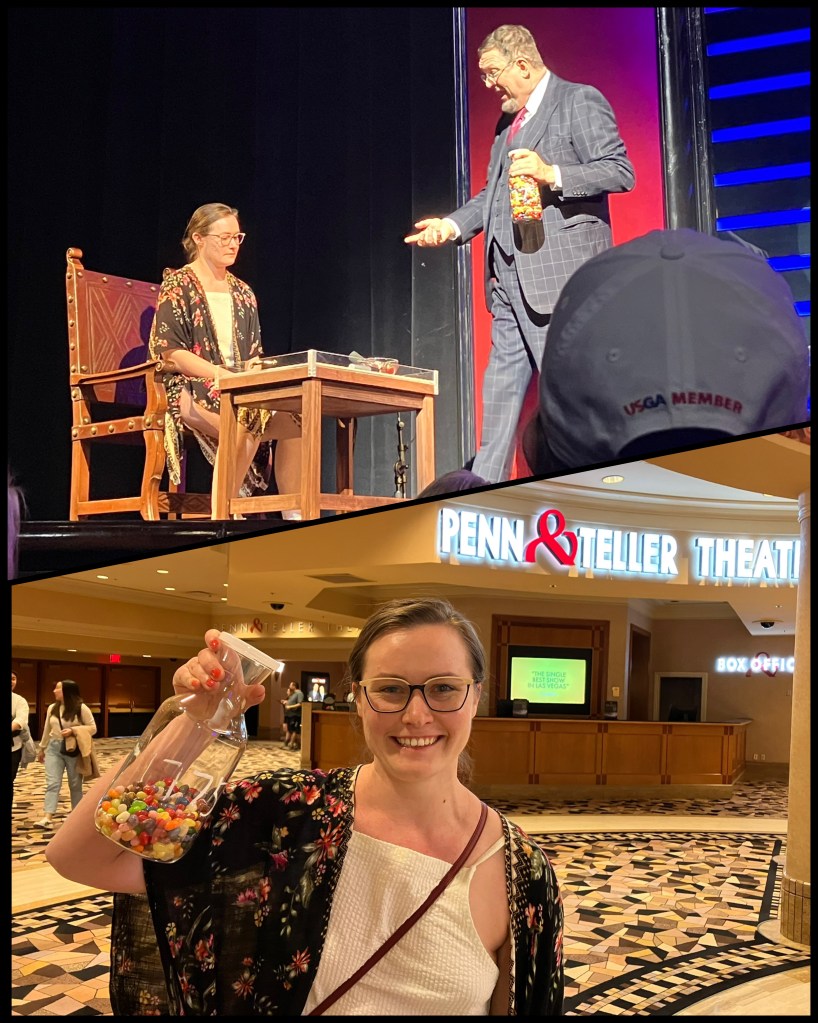
It was one of the best moments of my life.
References
Freakonomics. (2023, December 4). How important is your choice of words? – Freakonomics.
Optimizely. (2014). *Fab Case Study: Fab Uses A/B Test to Improve Customer Shopping Experience*. Optimizely Marketing Customer Stories. Retrieved December 7, 2023.
Metts, M. J., & Welfle, A. (2020). *Writing is designing: Words and the User Experience*. Rosenfeld Media.
Ben-David, Y. (2022). *The business of UX writing*. Book Apart.
Interested in partnering? Let’s talk to see how I can help you create a comfortable digital health experience. Drop me a note at evy.haan@gmail.com.
 Evy Haan | Content Designer & UX Writer