
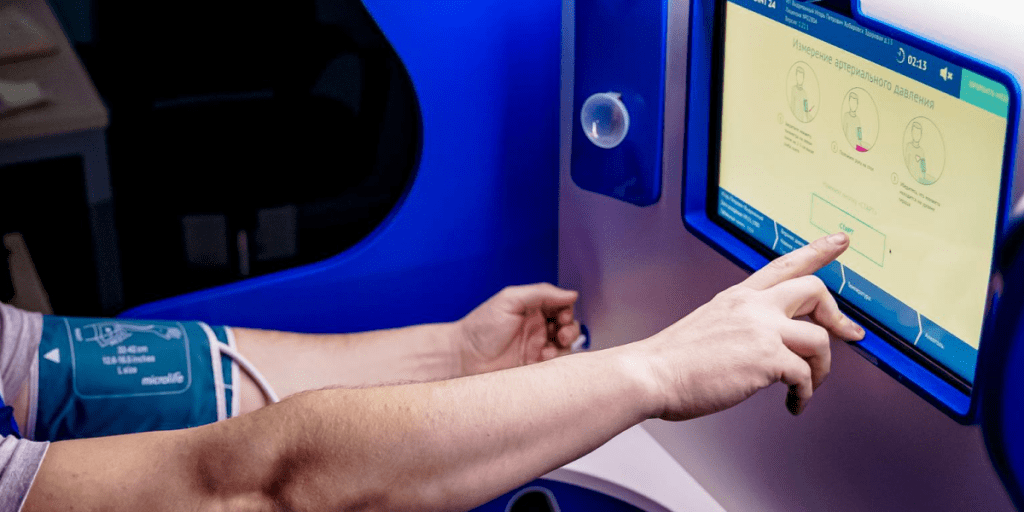
Digital therapeutics (DTx) is moving incredibly fast. It’s at the intersection of tech and health, providing medically-backed software intended to help patients treat and manage diseases, disorders, injuries, or conditions.
Pretty danged awesome if you ask me.
Recently, I chatted with Vanessa Jiménez Osorio about what it’s like working as a designer at Click Therapeutics, a DTx company.
Some of the work is exactly what you’d expect in a design team anywhere. But I was blown away by the unique challenges, team dynamics, the necessary skills designers need to navigate this field.
In Vanessa’s words: “it’s enriching, but a lot.”
So, what makes a DTx design role different?
Here are 4 of my big takeaways…
Designing for buy-in
Okay, yeah sure- it’s true for all digital products.
But there’s something different about getting buy-in for DTx, because…
DTx is a medical treatment.
It’s a prescription, just like prescription medications or specialist referrals.
There’s a bit of a mindshift to have patients separate how they understand DTx compared to any other ol’ commercial health app.
They need encouragement, reassurance, and a sense of security. And they need these things, not from the DTx organization, but from their own health provider.
This makes health providers the first-line audience for DTx products.
Providers need to determine which patients would most likely benefit and how it’ll fit into their overall treatment plan. To do that, they need concrete evidence that this product can work and what the outcomes could be.
There’s research
I don’t know why I was surprised to learn that DTx requires clinical trials.
In hindsight, it totally makes sense.
Just as any new medication or procedure, DTx platforms need FDA approval to go to market. This requires rigorous testing and detailed documentation.
There’s a necessary partnership between design teams and in-house science and clinical teams to design an entire medical trial procedure. From creating a control treatment, recruiting patients, evaluating the health outcomes of both treatment and control groups after a complete treatment cycle, and then iterating based on patient and clinical feedback about the UX. This can take years.
Though challenging and meticulous, passing each trial and moving to the next stage in the FDA approval process can be re-energizing. Reaching the next level is a confirmation of the effectiveness and a reaffirmation that the treatment will have a serious impact on patient health outcomes.
And then there’s research
Many DTx companies publish research studies about the health outcomes and UX of their products in science and clinical journals.
As a designer, it actually helps to keep abreast of what is being done – what’s working, what has yet to be tried.
So having research skills can make a critical difference in how you approach a digital treatment solution to a health problem.
Integration into the health care system
Think about it like this:
Say your doctor prescribes you a new medication. They send an order to your pharmacy. Your doctor, your pharmacy, and your insurance coordinate all the necessary bits of your health information to get your prescription ready. You’re not hardly involved (if you’re lucky). All you need to do is go pick up your meds (most of the time).
This is how DTx should work, too.
Integrating digital care tools into the healthcare system could remove a massive barrier to getting patients on board. From the moment it’s prescribed, a digital health prescription should be ready to go, already loaded with the patient’s data, tailored to their health situation and goals, and set up with their health insurance. All a patient should need to do is sign in.
Because it’s a highly regulated industry, I think this may be a challenge for a long time.
Hopefully, I’m wrong and we can get there sooner rather than later.
What’s it all mean for a UX content designer like me?
In DTx, UX design is just as much health science as it is design. Not only do I need to understand the principles of good content design, I’d also need to…
… know the health condition I work on pretty in-depth. I’d need to be able to understand the current research to understand how biotechnology can fit and move treatment forward (which is lucky for this nerd who enjoys curling up with a hot cup of tea and a scientific research paper. I have really wild Friday nights, I know.)
… be able to communicate with clinical experts and scientists in addition to the standard product, design, and engineering teams.
… understand the regulations of healthcare and clinical research and to ensure the product I’m working colors within the lines.
… know the healthcare system. I need to know the chain from ideation all the way through patient success, and the people, entities, and contexts at every link.
I feel like I should be daunted by how much more I need to learn and grow, but it actually has me fired up. The conversation gave me new ideas and resurfaced some old ones in the next steps forward in healthtech.
 Evy Haan | Content Designer & UX Writer